7 Secrets of Copywriting for Websites That Will 10x Your Sales
If you are a SaaS founder, an indie hacker, or an agency owner, you already know that getting traffic to your site is only half the battle. The real challenge is getting those hard-earned visitors to actually click the "Buy Now" or "Sign Up" button. You can have the most revolutionary software or the most incredible agency services, but if your words fail to communicate that value clearly, your visitors will bounce.
This is where copywriting for websites matters. It is the invisible bridge between a casual browser and a paying customer. In this guide, we are going to dive deep into what it takes to write copy that converts, how to structure your messaging, and why pairing your words with high-quality design is the ultimate unfair advantage.
Key Takeaways
- • Focus on Benefits: Highlight what the customer gains rather than just listing technical features.
- • Nail the Hero Section: You only have 3-5 seconds to grab attention. Use a clear, benefit-driven headline.
- • Write for Scannability: Avoid walls of text. Use short paragraphs, bullet points, and clear headers to make reading effortless.
- • Pair Copy with Great UI: Even the best words fail if the design is clunky. Beautiful, animated UI components boost trust and conversions.
Table of Contents
- What Exactly is Web Copywriting?
- Why SaaS and Agencies Need a Home Page Copywriter
- 7 Actionable Webstie Copywriting Tips to Boost Conversions
- How to Pair Your Copy With High-Converting Designs
- Common Mistakes to Avoid
- Frequently Asked Questions (FAQ)
- Conclusion: The Perfect Marriage of Words and UI
What Exactly is Web Copywriting?
Essentially, web copywriting is the strategic process of writing digital content designed to persuade a reader to take a specific action. While traditional content writing (like the blog post you are reading right now) is primarily meant to educate, inform, or entertain, copy is meant to sell. It is salesmanship in print, or in this case, on a screen.
When you are doing copywriting for website pages, your primary goal is to guide the user journey. You are anticipating their objections, highlighting the benefits of your product, and providing a clear, frictionless path to purchase. This applies to your landing pages, your pricing page, your feature pages, and especially your homepage.
For a SaaS founder or an indie hacker, the stakes are incredibly high. You do not have the massive brand recognition of a Fortune 500 company. When someone lands on your site, they are skeptical. They are wondering, "What is this?" and "Why should I care?" Good copy answers those questions within the first 5 seconds. If you fail to do that, you lose the prospect forever.
Why SaaS and Agencies Need a Home Page Copywriter
The homepage is the most important piece of digital real estate you own. It is the front door to your business. If the front door is confusing, cluttered, or locked, nobody is coming inside.
This is why many successful startups eventually hire a specialized home page copywriter. The homepage has to do a lot of heavy lifting. It must immediately communicate your unique value proposition (UVP), establish trust and authority, appeal to different customer segments, and direct users to the next logical step in your funnel.
If you are an agency developer or owner, you know that your homepage needs to sell your expertise. Clients are looking for a partner they can trust to build their digital presence. Your copy needs to exude confidence, showcase your portfolio without being boastful, and clearly articulate the ROI of working with you.
For SaaS products, the homepage must quickly distill complex technical features into easily digestible benefits. Developers often suffer from the "curse of knowledge." They know their product so intimately that they write copy filled with technical jargon that completely alienates the average buyer. A great copywriter acts as a translator, turning "AES-256 encrypted multi-tenant architecture" into "Your data is perfectly safe and scales with your business."
Even if you cannot afford to hire a professional right now, adopting the mindset of a conversion-focused writer is crucial. You must learn to ruthlessly edit your own words, strip away the fluff, and focus entirely on the customer's needs and pain points.
7 Actionable Webstie Copywriting Tips to Boost Conversions
If you want to start seeing better conversion rates today, here are 7 proven webstie copywriting tips that you can apply immediately to your SaaS or agency site.
1. Nail the Hero Section
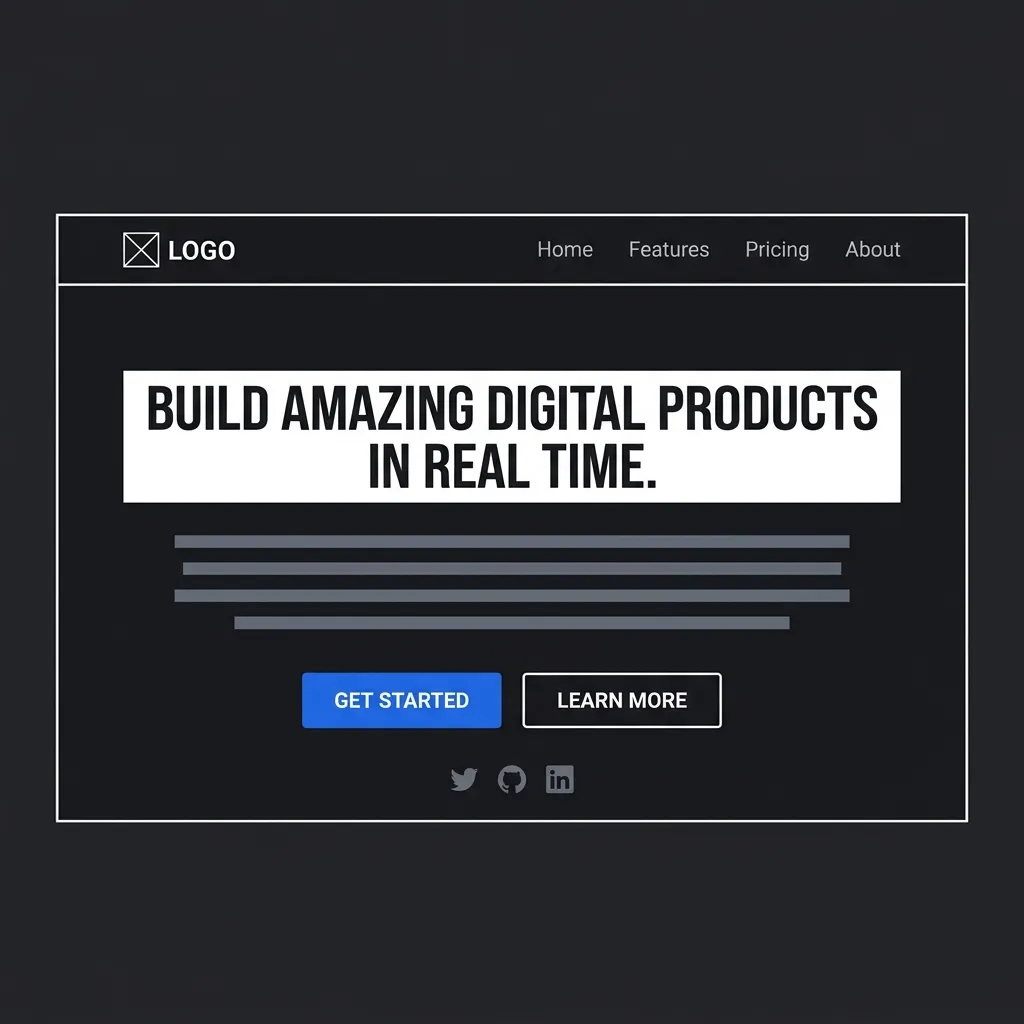
Your hero section is the very top part of your webpage before the user scrolls. You have about 3 to 5 seconds to capture their attention. Your hero section needs three things: a clear, benefit-driven headline; a supporting subheadline that explains how you deliver that benefit; and a prominent, high-contrast Call to Action (CTA).
Stop trying to be clever. "Unleash your digital synergy" means absolutely nothing. Instead, try something clear like "Build Beautiful React Apps in Half the Time." Clarity always beats cleverness.
2. Focus on Benefits, Not Just Features
This is the golden rule of sales. Features tell, benefits sell. A feature is what your product does; a benefit is what the user gets out of it. For example, if you are selling a component library:
- Feature: "Contains 100+ Framer Motion components."
- Benefit: "Launch your stunning, animated website this weekend without writing complex animation logic from scratch."
Always ask yourself "So what?" after listing a feature. The answer to that question is your benefit.
3. Leverage the Power of Social Proof
No one wants to be the first person to try an unproven product. Humans are herd animals; we look to others to see what is safe and popular. You need to sprinkle social proof throughout your copy. Use specific, quantifiable testimonials. A quote that says "This tool saved us 15 hours a week and increased our signups by 20%" is infinitely more powerful than "Great tool, highly recommend."
If you are an agency, display the logos of the clients you have worked with. If you are a SaaS, show your user count.
4. Write for Scannability
People do not read on the internet; they scan. They look for headlines, bullet points, bold text, and images. According to the Nielsen Norman Group, users only read about 20% of the text on the average page. If you confront your visitors with massive, intimidating walls of text, they will leave immediately.
Keep your paragraphs short (no more than 3 to 4 sentences). Use clear, descriptive subheadings so a user can get the gist of your page just by scrolling. Use bulleted lists whenever you are presenting multiple related points. Additionally, you can check out resources from HubSpot to learn more about optimizing your content formatting for better readability and engagement.
5. Address Objections Head-On
Your visitors are looking for a reason not to buy. They are wondering if it's too expensive, if it will integrate with their current tech stack, or if it's too hard to learn. Do not hide from these objections. Bring them up yourself and dismantle them. A great place to do this is in a Frequently Asked Questions (FAQ) section near the bottom of your landing page. By answering their doubts proactively, you build immense trust.
6. Make Your CTAs Action-Oriented
"Submit" and "Click Here" are terrible CTAs. They are boring and tell the user nothing about what happens next. Your CTA should complete the sentence "I want to..."
Instead of "Submit", use "Get My Free Audit." Instead of "Sign Up", use "Start Building for Free." Use strong action verbs that inspire momentum.
7. Match the Conversation in Your Customer's Head
The best copy doesn't sound like a textbook; it sounds like you are reading your customer's diary. To do this, you need to use the exact words and phrases your customers use. If you are an indie hacker, go read reviews of your competitors' products. Look at the complaints on Reddit or Twitter, or check out resources from experts like Copyhackers on voice-of-customer research. Steal the exact phrasing people use to describe their frustrations, and use it in your copy to show that you truly understand their pain.
How to Pair Your Copy With High-Converting Designs

Many writers ignore this fact: the best copywriting for websites will completely fail if it is presented in a clunky, ugly, or outdated design.
Today, aesthetics equal trust. When a potential customer lands on your SaaS landing page, they make a split-second judgment about your credibility based entirely on how the site looks. If it looks like it was built in 2005, they will assume your software is equally outdated.
Your copy and your design must work in perfect harmony. The design exists to guide the user's eye to your most important copy, and your copy exists to give meaning to the design.
This is why you need a premium UI library like ogBlocks, a beautifully animated React component library built with Tailwind CSS and Framer Motion. By pairing your new copy with ogBlocks, you get:
- Pre-built Visual Hierarchy: Layouts that naturally enforce scannability and structure.
- High-Converting Layouts: Ready-to-use components and 3D carousels that build instant trust.
- Plug-and-Play Design: Copy and paste pixel-perfect, animated components without wasting hours writing CSS from scratch.
Don't let your hard-earned copy go to waste on a generic template. Explore the ogBlocks library today and transform your website into a high-converting machine.
Common Web Copywriting Mistakes to Avoid
As you start refining your site, be sure to avoid these frequent pitfalls that kill conversions:
- Talking About Yourself Too Much: Count how many times you use the words "we," "our," and "I" versus the word "you." Your customer doesn't care about your company's history; they care about how you can solve their problem. Shift the focus to the reader.
- Using Vague Jargon: Words like "innovative," "synergistic," and "next-generation" have lost all meaning. Be specific. Instead of "innovative analytics," say "analytics that show you exactly who is buying your product in real-time."
- Weak Value Propositions: If your competitor could put your headline on their website and it would still make sense, your value proposition is too weak. You need to identify what makes you uniquely better.
- Friction in the Buying Process: If your copy convinces them to buy, but your checkout process takes 15 steps and requires a phone number and a blood sample, they will abandon the cart. Keep forms and signup flows as minimal as physically possible.
Frequently Asked Questions (FAQ)
What is the difference between content writing and website copywriting? Content writing focuses on educating and informing the audience, typically through blog posts, whitepapers, and long-form articles. It builds authority and SEO value over time. In contrast, web copywriting is heavily focused on driving a specific action right now, like signing up for a SaaS product, booking a demo, or buying a UI component library.
How long should my homepage copy be? Your homepage copy should be as long as it needs to be to overcome buyer objections and explain your value proposition, but no longer. Focus on clarity and brevity. A good home page copywriter will prioritize scannability over word count, using design elements to break up the text.
Should I hire a home page copywriter or do it myself? If you have the budget, hiring a professional home page copywriter is an excellent investment because they deeply understand user psychology, persuasive frameworks, and conversion optimization. However, if you are a bootstrapped indie hacker or SaaS founder, you can write it yourself using proven templates, focusing heavily on customer research, and iterating based on data.
How does design affect my copywriting? Design dictates how your copy is consumed. Even the most persuasive words will fail to convert if they are buried in an unreadable wall of text with poor contrast. Pairing your copy with beautiful, animated UI components from a library like ogBlocks ensures your message is delivered in an engaging, trustworthy, and readable format.
Conclusion: The Perfect Marriage of Words and UI
Mastering copywriting for websites is an ongoing process of testing, learning, and refining. By focusing on your customer's deep desires, addressing their fears, and writing with extreme clarity, you can dramatically increase the number of visitors who become paying users.
But remember, words do not live in a vacuum. The most successful SaaS companies and agencies in the world understand that incredible copy must be housed in incredible design.
Don't let your hard work go to waste on a generic, boring template. Give your words the presentation they deserve. Get access to ogBlocks today and start building animated, high-converting React interfaces that will make your competitors jealous and turn your visitors into lifelong buyers.
Written by Karan
Karan is a React engineer and the founder of ogBlocks, building high-performance UIs for SaaS.