
Your Frontend Tech Stack is Outdated: Here’s What Top 1% Use in 2026
This article is for frontend developers, freelancers, and agencies looking to optimize their workflow, choose the right tools, and ship world-class products significantly faster in 2026.
Choosing the right frontend tech stack is the most critical technical decision you will make this year. Whether you are building a lightweight Minimum Viable Product (MVP), a dynamic eCommerce storefront, or a large-scale enterprise web application, your frontend stack defines your project's performance, scalability, and ultimately, your team's developer experience (DX).
In this comprehensive 2026 guide, we will dive deep into exactly what makes a brilliant frontend developer tech stack, compare the top modern tools on the market, and show you exactly how combining these core technologies with a beautiful, pre-built component library can completely transform your agency or freelance business revenue.
Key Takeaways
- The Ultimate Setup: Use Next.js, Tailwind CSS, TypeScript, Zustand, Vite, and ogblocks in 2026.
- Performance is Mandatory: Modern frameworks must output incredibly optimized, fast-loading, server-rendered applications to pass Core Web Vitals.
- UI Libraries Save Massive Time: Don't build interface elements from scratch. Leverage premium libraries like ogblocks to save hundreds of billable hours per project.
- State Management Evolution: Zustand and TanStack Query have largely replaced complex Redux architectures for both local and server state handling.
Table of Contents
- What Makes a Great Frontend Tech Stack in 2026?
- Level 1: The Core Foundation & Languages
- Level 2: Core Frontend Frameworks & Libraries
- Level 3: Styling & CSS Frameworks
- Level 4: Build Tools and Bundlers
- Level 5: State Management and Data Handling
- Level 6: Testing and Quality Assurance
- Level 7: Deployment, Hosting, and CI/CD
- Frequently Asked Questions (FAQ)
- Why ogblocks Should Be in Your Stack
- Conclusion & Next Steps
What Makes a Great Frontend Tech Stack in 2026?
A frontend tech stack (often just called a frontend stack) is the cohesive collection of software programs, frameworks, libraries, build tools, and programming languages used to develop the user interface (UI) and user experience (UX) of a web application. The frontend stack handles everything the user interacts with directly on their screen.
But the technology landscape moves blazingly fast. What worked perfectly in 2022 might be considered heavily legacy today. As we navigate 2026, the criteria for choosing your tools have shifted significantly. Today, a world-class frontend technology stack must definitively tick three specific boxes:
- Performance by Default: With Google's ever-strict Core Web Vitals (INP, LCP, CLS) heavily impacting SEO rankings, your stack must output highly optimized, fast-loading, server-rendered or statically generated assets. The end-user should never pay the performance cost for your complex developer tools. If your site is slow, your bounce rate drastically increases, and conversions plummet.
- Superior Developer Experience (DX): Your build times should be measured in milliseconds, not minutes. Hot Module Replacement (HMR) must be instant so that when you save a file, the browser updates instantly without losing state. If your tools are slow and cumbersome, your business operations are slow. For freelancers and agencies, time is literal money.
- Ecosystem and Maintainability: Using extremely niche, bleeding-edge frameworks can be exciting for a massive weekend hackathon, but when you hit a serious roadblock with a client project, you want a massive community and ecosystem to rely on. You want thousands of StackOverflow answers, mature documentation, and long-term support.
Let's break down the ultimate frontend stack layer by layer so you can make an informed decision for your next major project.
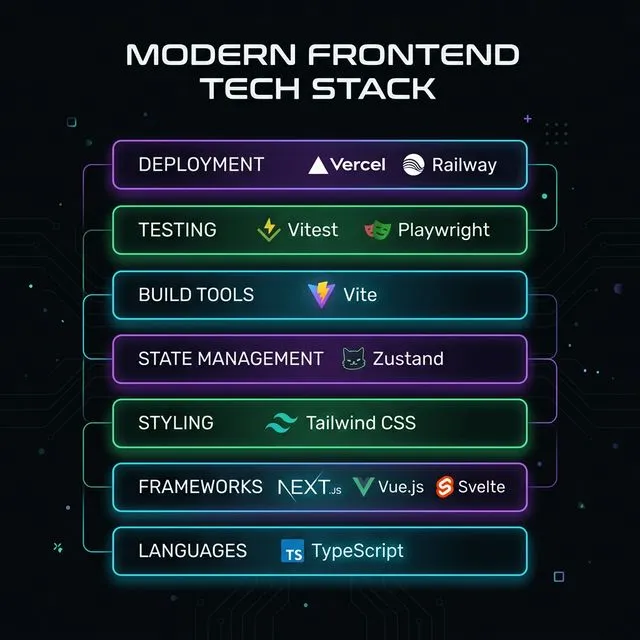
Level 1: The Core Foundation & Languages
Every frontend stack, no matter how complex, starts with the foundational trio of the web: HTML, CSS, and JavaScript. But how we utilize them in 2026 has radically evolved.
TypeScript
JavaScript remains the undisputed king of web programming. In 2026, writing plain Vanilla JavaScript for large-scale, complex applications is practically obsolete.
TypeScript is now the absolute industry standard for any serious, production-ready project. By adding optional static typing to JavaScript, TypeScript catches syntax and logic errors at compile time rather than run time in the user's browser. According to the 2024 Stack Overflow Developer Survey, TypeScript is used by over 38.5% of all developers globally and ranks as the 4th most popular programming language. Among professional frontend teams, adoption rates exceed 70%. If you want to learn how TypeScript integrates with animation libraries, check out our guide on using TypeScript in Framer Motion.
Why should an agency adopt TypeScript?
- Improves Code Safety: It makes massive refactoring phases incredibly safe because the compiler will immediately yell at you if you break a dependent component.
- Superior Auto-Completion: It improves intelligent code completion (IntelliSense) in IDEs like VS Code.
- Self-Documenting Code: By defining the expected 'shape' of your data structures and component props, the code explains itself to new developers joining your team.
Recommendation: Default to TypeScript for any project that will take more than a single weekend to build, or any project that involves more than one frontend developer.
Level 2: Core Frontend Frameworks & Libraries
The framework or library you choose is the absolute backbone of your frontend developer tech stack. It dictates your architecture, data flow, component design, and heavily influences which third-party plugins you can utilize.
React and Next.js
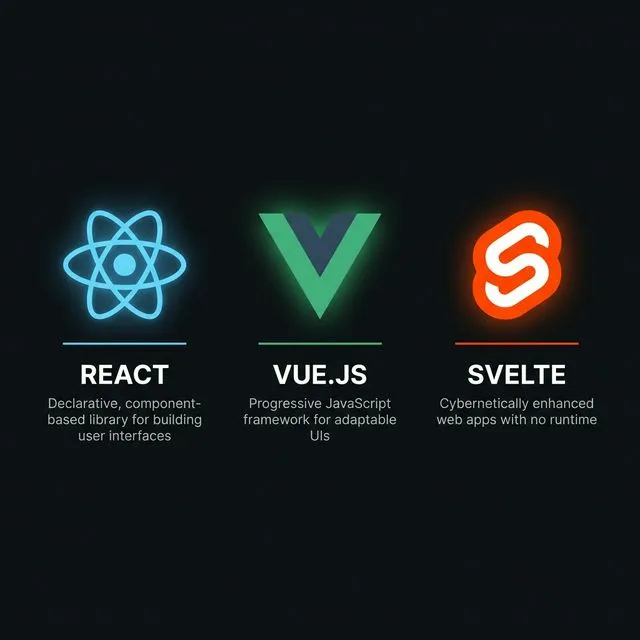
React remains the overwhelmingly dominant library for building user interfaces. Its intuitive component-based architecture and massive third-party ecosystem make it the safest choice for freelancers and agencies. If a client needs a project taken over by another developer in two years, React codebases are the easiest to hand off.
However, writing a plain client-side Create-React-App is firmly in the past. Today, Next.js by Vercel is the definitive React framework. It provides:
- Server-Side Rendering (SSR) and Static Site Generation (SSG): This is crucial for both SEO and initial load performance.
- App Router Architecture: A modern, deeply nested, file-system-based routing architecture that leverages the latest React features like React Server Components (RSC).
- API Routes: Allowing you to build full-stack applications entirely within a single unified codebase.
Vue.js and Nuxt
If React isn't your preference or your team's strong suit, Vue.js and its powerful meta-framework counterpart Nuxt are an incredible alternative. Vue is repeatedly praised in developer communities for its incredibly gentle learning curve, beautifully clean template syntax, and highly performant reactivity system via the Composition API. Nuxt brings the exact same server-rendering and routing benefits to Vue that Next.js brings to React.
Svelte and SvelteKit
Svelte takes a radically different approach. Instead of shipping a bulky runtime library to the browser, Svelte compiles your declarative code down to tiny, highly optimized framework-less Vanilla JavaScript at build time. There is no virtual DOM overhead, meaning blazing-fast runtime performance and incredibly small bundle sizes. SvelteKit is the full-stack framework for Svelte, and it has gained massive traction for developers who want the utmost performance, minimal boilerplate, and an elegant developer experience.
Quick Framework Comparison
| Feature | React + Next.js | Vue + Nuxt | Svelte + SvelteKit |
|---|---|---|---|
| npm Weekly Downloads | ~126M (React) / ~45M (Next.js) | ~11M (Vue) | ~4.3M (Svelte) |
| Learning Curve | Moderate | Easy | Easy |
| Bundle Size (min) | ~44kb | ~33kb | ~2kb |
| SSR Framework | Next.js | Nuxt | SvelteKit |
| Ecosystem Size | Massive | Large | Growing |
| Hiring Pool | Largest | Moderate | Small |
| Best For | Agencies, enterprise | Startups, rapid prototyping | Performance-critical apps |
Recommendation: Pick Next.js for maximum ecosystem support, rapid hiring, and massive employability. Pick Vue/Nuxt for developer happiness, clean template syntax, and ease of adoption. Pick SvelteKit if performance and tiny bundle sizes are your absolute number one priorities.
Level 3: Styling & CSS Frameworks
Styling has seen the most dramatic, highly-debated shift in the modern frontend tech stack. Over the past five years, the industry has aggressively moved away from massive global CSS files, complex BEM naming conventions, or heavy runtime CSS-in-JS solutions. Utility-first CSS has definitively won the war.
Tailwind CSS
Tailwind CSS is an incredibly popular utility-first CSS framework that allows you to style your components directly within your HTML markup or React JSX. With over 87 million weekly npm downloads as of early 2026, it completely removes the dreadful need to invent semantic class names, ensures a scalable and consistent design system right out of the box, and automatically purges all unused styles—resulting in minuscule production CSS bundle sizes (often under 10kb).
Even with the immense power of Tailwind CSS, building highly aesthetic, fully accessible, and perfectly responsive components completely from scratch—such as complex datatables, animated hero sections, accessible dropdown menus, or animated card components—takes hundreds of highly-paid developer hours. This is exactly why pre-built component libraries have become essential for agencies and freelancers looking to ship faster.
Level 4: Build Tools and Bundlers
How does your carefully crafted code transition from local development files to highly optimized browser bundles?
Vite
Vite (the French word for "quick") has completely taken over the build tool ecosystem, firmly dethroning the once-dominant Webpack. Created by Evan You (the creator of Vue), Vite provides an outrageously fast local development server fueled by native browser ES modules. According to the State of JS 2024 survey, Vite has a 98% satisfaction rating among developers who have used it—the highest of any build tool.
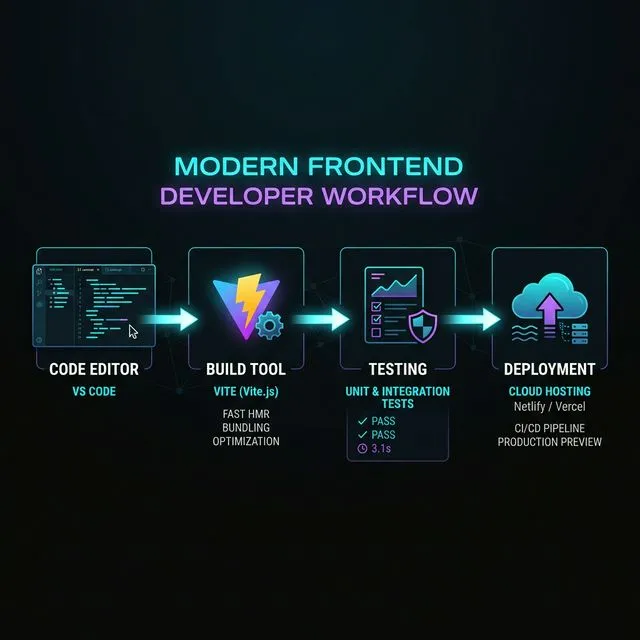
With Vite, Hot Module Replacement (HMR) takes literal milliseconds (benchmarked at under 50ms even on large codebases), regardless of how massive your application grows. When you push to production, it leverages Rollup under the hood to output highly optimized, heavily minified static assets. If you are building standard React or Vue Single Page Applications (SPAs) without a meta-framework like Next.js, Vite is the only modern build tool you should consider in 2026.
Level 5: State Management and Data Handling
As frontend applications become increasingly complex, effectively managing state (the data your UI relies on) across dozens of nested components becomes a massive hurdle.
Local State vs. Global State
For years, the default answer to state management in React was Redux. While Redux Toolkit has vastly improved the developer experience by reducing boilerplate, it is often overkill for 80% of modern applications.
Zustand
Today, the preferred tool for global state management in the React ecosystem is Zustand. Zustand is an incredibly small, fast, and highly scalable bearbones state-management solution using simplified flux principles. It has a comfortable API based on hooks, requires virtually zero boilerplate, and doesn't wrap your entire application in context providers, which avoids annoying re-render issues.
TanStack Query
A major revelation in the past few years is realizing that fetching API data is not local application state—it's asynchronous server state. TanStack Query handles caching, background updates, stale data fetching, and loading states automatically. It entirely eliminates the need for massive Redux reducers specifically dedicated to tracking loading states from API promises.
Level 6: Testing and Quality Assurance
A professional frontend tech stack must prioritize stability and bug prevention.
Vitest
If you are using Vite as your build tool, you absolutely should be using Vitest. It functions as a drop-in, significantly faster replacement for Jest. Because it uses the exact same configuration as your Vite project, you don't need to maintain two separate, complicated pipelines for building and testing.
Playwright
For complete End-to-End testing—simulating exactly what real users experience when they click through your application—Playwright by Microsoft has emerged as the definitive champion. It offers cross-browser support (Chromium, Firefox, and WebKit), incredibly fast execution speeds, and brilliant auto-waiting mechanisms, avoiding the notorious "flakiness" that plagued older generation tools like Selenium.
Level 7: Deployment, Hosting, and CI/CD
What good is a lightning-fast application if deploying it is a horrendous, painful nightmare?
Vercel
For modern frontend frameworks, particularly Next.js, Vercel is the undisputed king of frontend application hosting. Vercel provides zero-configuration deployments. You simply connect your GitHub repository, and Vercel automatically builds, optimizes, and deploys every single commit to a globally distributed Edge Network. It instantly provides preview URLs for every pull request, allowing your agency to easily share progress updates with clients securely before merging code into production.
Railway
When your frontend project needs to grow into a more aggressive full-stack platform involving custom databases (like PostgreSQL, MySQL, or Redis), background worker tasks, and persistent storage, Railway is an astonishingly powerful solution. Railway shines in its ability to provision complete deployment environments and databases incredibly fast without any complex DevOps overhead, serving as a developer-friendly alternative to traditional platforms like AWS.
Frequently Asked Questions (FAQ)
What is a frontend developer tech stack? A frontend developer tech stack is the complete combination of programming languages (like JavaScript or TypeScript), frameworks (like React or Vue), styling libraries (like Tailwind CSS and ogblocks), build tools (like Vite), and deployment platforms used to create the visible, interactive parts of a web application or website.
Why is choosing the right frontend technology stack important? Choosing the right frontend technology stack determines your project's long-term maintainability, market scalability, and application loading speed. A modern stack drastically reduces technical debt, improves developer productivity through fast tooling, and ensures your application provides a smooth, bug-free, and high-performance experience to end-users.
Can I mix different tools in my frontend stack? Yes, frontend stacks are highly modular by design. You can seamlessly combine React for your UI framework, Zustand for handling state, Tailwind CSS along with the ogblocks component library for rich styling, and Vite for your build process. The key is ensuring the tools you select integrate smoothly together and possess large support communities.
Is TypeScript mandatory for a frontend stack in 2026? While technically not mandatory, TypeScript is highly recommended and considered an absolute industry standard for professional projects. It dramatically reduces runtime bugs, significantly improves the developer experience with excellent IDE support, and provides immediate, automatic documentation for your codebase, making it indispensable for team collaborations and agency workflows.
Why ogblocks Should Be in Your Stack
If you are a freelancer or a development agency, time is your most valuable, finite asset. Building highly aesthetic, fully responsive components from scratch—like animated hero sections (which we cover in our Framer Motion and Next.js guide)—takes hundreds of billable developer hours.
ogblocks is the missing piece in your frontend technology stack. It provides a massive suite of beautifully designed, highly interactive, and fully accessible React components built for Next.js and Tailwind CSS.
- Ship 10x Faster: Copy and paste a breathtaking component in 30 seconds instead of building one from scratch over 3 days.
- Premium Aesthetics: Clients are instantly wowed by smooth animations, micro-interactions, and modern layouts that generic free libraries simply cannot match.
- 100% Customizable Source Code: You own the code. Tweak, extend, and brand it however you want—no npm lock-in.
- Instant ROI: A single ogblocks license pays for itself on your very next client project.
Get the ogblocks component library and upgrade your stack today!
Conclusion & Next Steps
Building a successful web application in 2026 requires making smart architecture decisions early. The ultimate frontend tech stack combines the strict safety of TypeScript, the immense power of Next.js, the utility-first convenience of Tailwind CSS, and the blistering speed of Vite.
Stop wasting development hours building generic UI components. Accelerate your workflow, significantly increase your profit margins, and deliver breathtaking web applications that your clients will absolutely adore. Check out ogblocks today.
Written by Karan
Karan is a React engineer and the founder of ogBlocks, building high-performance UIs for SaaS.